PropList Blog
14th April 2026
These days, the UK commercial property market is less about headline cities and more about smart, strategic locations where demand, affordability, and growth intersect.
London will always be London, but the real momentum is happening in regional towns, commuter belts, and logistics-driven hubs. In unsuspecting cities where yields are stronger, entry prices are lower, and tenant demand is evolving fast.
So, where is “smart money” turning its eye in 2026 and, more importantly, why? Let’s look into it:
What Makes a City a Commercial Property Investment Hotspot?
Before exploring locations, it’s worth understanding what separates a good investment from a genuinely high-performing one.
The strongest commercial property hotspots tend to share a few core traits:
- Strong tenant demand - Growing sectors (logistics, life sciences, SMEs) drive consistent occupancy
- Affordability vs yield balance - Lower entry prices with healthy rental returns outperform overly “hot” markets
- Connectivity & infrastructure - Rail upgrades, road access, and proximity to major cities matter more than ever
- Economic drivers - Universities, business parks, and regeneration projects attract long-term occupiers
- Flexibility of stock - Assets that can adapt (industrial to office, retail to mixed-use) future-proof value
To put it simply: a hotspot isn’t just a bustling area, it’s economically active, connected to people, businesses and investors, and still undervalued relative to its potential.
Top UK Locations to Watch in 2026
Here are the UK cities we’ve got our eyes on for the next few years:
Harlow
Harlow is quickly moving from “commuter town” to a hub for innovation and life sciences. We are seeing big investments in the Harlow Enterprise Zone and Science Park, which is attracting biotech, healthcare, and logistics occupiers - consistent, solid tenants.
For investors, the appeal is clear:
- Strong demand for industrial and flexible workspace
- Proximity to London without London pricing
- Ongoing infrastructure and employment growth
Harlow is a classic example of a town transitioning into a high-value commercial cluster because of specific interest from the science and business world.
Waltham Abbey
Lying just 13.5 miles outside of central London, Waltham Abbey is close enough to the capital to benefit from its proximity, but far enough for the prices to be more reasonable.
Key drivers for this hotspot include:
- Access to the M25 corridor and logistics routes
- Spillover demand from London-based businesses
- Limited supply due to Green Belt restrictions
Its commercial viability isn’t all tied up in logistics, either. Waltham Abbey, named after its namesake church, is a beautiful little town set amid rolling green hills - a traditional market town worthy of the name. And since the importance of company culture is now clear, we’re not surprised that this town is a strong option for investors targeting logistics, trade counters, and SME occupiers.
Bury St Edmunds
Often overlooked, Bury St Edmunds is actually a high-quality regional market town with a diverse economic base. Its manufacturing, food production, and retail sectors are strong and growing.
Why it stands out:
- Stable tenant demand from local and regional businesses
- Strong retail and tourism economy
- Lower volatility compared to major cities
We consider this the perfect “defensive” investment location with consistent and long-term appeal for businesses and the economy.
Milton Keynes
Milton Keynes continues to stand out as a serious logistics and distribution powerhouse. The city, recently named one of the top cities for high wages, innovation and highest housing growth, is driven by infrastructure investment and convenient central UK positioning. The Cities Outlook 2025 report also shows that workers in Milton Keynes earn, on average, £40,596, while the national average is £37,206.
This city offers:
- High demand for warehousing and industrial space
- Excellent connectivity (road and rail)
- Strong corporate and SME ecosystem
This is ideal for investors who are focused on quick, scalable assets and income-generating resources.
Slough
Slough remains one of the UK’s most established commercial hubs. Just 20 miles west of central London and 19 miles north-east of Reading, this city sits at the intersection of the M4, M40 and M25 motorways. Its position has also been supercharged by the Elizabeth Line, and with quick access to Heathrow Airport.
What differentiates it from other areas:
- Higher rental yields than central London
- Strong corporate presence
- Continued inward investment
Slough remains a reliable performer, which we expect will continue for many, many years to come. It’s a place that blends yield and long-term growth together for success.
Watford
This is another town that offers a compelling mix of being close enough to London for business on demand, but far enough to have its own independent economic identity. It also has a lovely balance of historic charm and modern amenities that make living and working here a real pleasure.
Here’s what makes Watford particularly interesting:
- Growing tech and SME sectors
- Regenerated high street and mixed-use developments
- Strong commuter demand
Watford’s sectors are a balanced mix of office space, retail, and flexible workspaces.
Southend-on-Sea
Southend is an attractive seaside town 40 miles east of central London. It’s growing into a creative and entrepreneurial hub, supported by regeneration and improved transport links. As a coastal city with award-winning beaches, it also offers great investment opportunities in the hospitality sector.
Here’s what Southend-on-Sea is getting right:
- Attractive entry pricing
- Diverse tenant base (retail, creative, hospitality)
- Growing appeal for SME’s
This city is a value-driven location with plenty of potential. It has relatively low entry prices and steady demand from commuters and residents.
Manchester
Manchester continues to dominate as a northern economic engine. This city has strong rental growth forecasts and a thriving business ecosystem with a high ROI.
The city is expanding in:
- Growth across tech, finance, and media
- Significant population and employment expansion
- Strong investor demand
We are seeing a long-term growth market with depth and resilience in this area. Even though the city is expanding quite quickly, there are still multiple top-tier investments to be made.
Birmingham
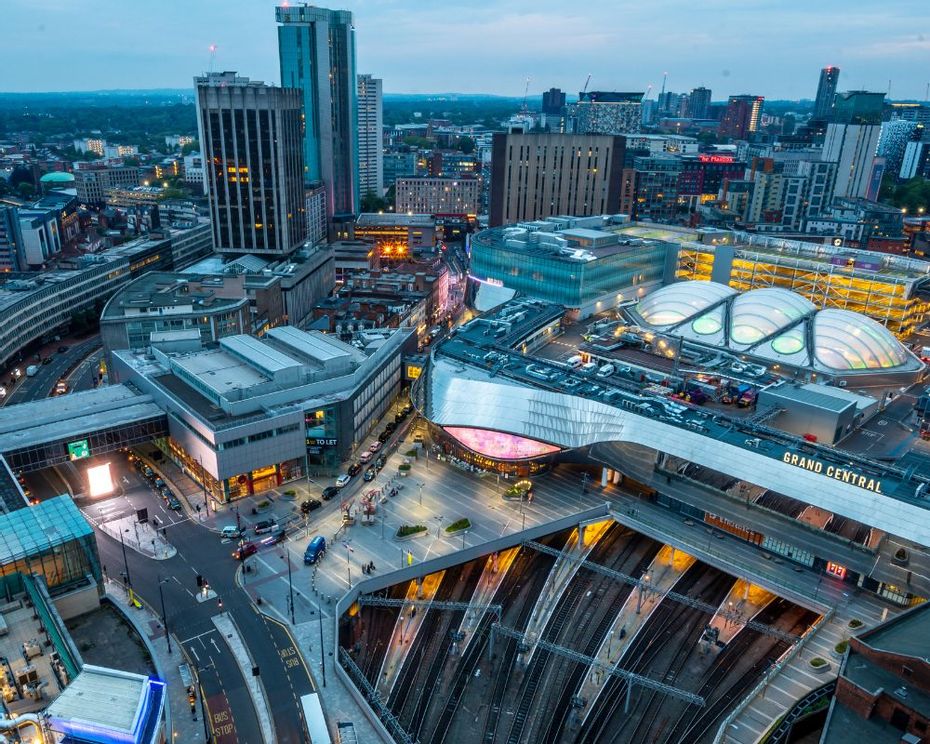
While Birmingham is the second-largest city in the UK, it’s still often overlooked for commercial investment. Birmingham’s ongoing regeneration and major infrastructure investment make it one of the most strategically important commercial centres.
Birmingham boasts features like:
- Major projects like Paradise and HS2 influence
- Attraction to major corporate occupiers like Deutsche Bank and Deloitte
- Diverse economic base
This is a city where infrastructure meets great opportunities. The Big City Plan, which is a 20-year City Centre Masterplan, aims to encourage and support Birmingham’s transformation into a world-class city centre. It’s creating a big pull for businesses to invest in high-demand commercial property.
Ultimately, It’s Not Just Where, It’s Why
The best-performing commercial property locations in 2026 aren’t just the biggest names on the map; they’re the places where economic activity, affordability, and future growth are set to thrive.
For investors, the opportunity lies in spotting the undervalued locations with strong fundamentals. It’s often the underdogs that give the most in return.
That said, understanding where to invest is only half of the equation. The next step is finding the right asset in the right location for your investment portfolio.
Fortunately, that’s our area of expertise! We offer a wide range of commercial properties for sale, including hotels, office spaces, pubs and retail premises. Browse commercial properties for sale on PropList and compare opportunities across the UK.
Archives
- All
- May 2026
- Apr 2026
- Mar 2026
- Jan 2026
- Dec 2025
- Nov 2025
- Oct 2025
- Sep 2025
- Oct 2023
- Jun 2023
- May 2023
- Dec 2022
- Apr 2020
- Mar 2020
- Jan 2020
- Sep 2019
- Jul 2019
- Jun 2019
- May 2019
- Apr 2019
- Mar 2019
- Feb 2019
- Jan 2019
- Dec 2018
- Nov 2018
- Oct 2018
- Sep 2018
- Aug 2018
- Jul 2018
- Jun 2018
- May 2018
- Apr 2018
- Mar 2018
- Feb 2018
- Jan 2018
- Nov 2017
- Mar 2017